Jews have lived in Morocco for more than two thousand years. By the middle of the 20th century the country had the largest Jewish community in the Arab world, and Moroccan Jews today live from Israel to France and Canada. In Morocco itself, a community of a few thousand remains, mostly in Casablanca, and the heritage is protected and visited: the 2011 constitution names the Hebrew heritage as one of the components of national identity.
A short history
- Antiquity: Jewish communities lived in the Roman province of Mauretania; a Hebrew-inscribed tombstone has been found at Volubilis.
- Middle Ages: Fes became a centre of Jewish learning; the philosopher Maimonides lived there in the 12th century.
- 15th century: the first mellah (Jewish quarter) was created in Fes, next to the royal palace. After 1492, Jews expelled from Spain and Portugal settled in Moroccan cities.
- 18th–19th centuries: Jewish merchants made Essaouira (Mogador) a major trading port.
- 20th century: most of the community emigrated after 1948 and in the following decades.
What is a mellah?
A mellah is the historic Jewish quarter of a Moroccan city, usually walled and close to the royal palace. You recognise it by its houses with balconies and windows on the street, unlike the inward-looking houses of the medina.
Where to see Jewish heritage, city by city
Casablanca
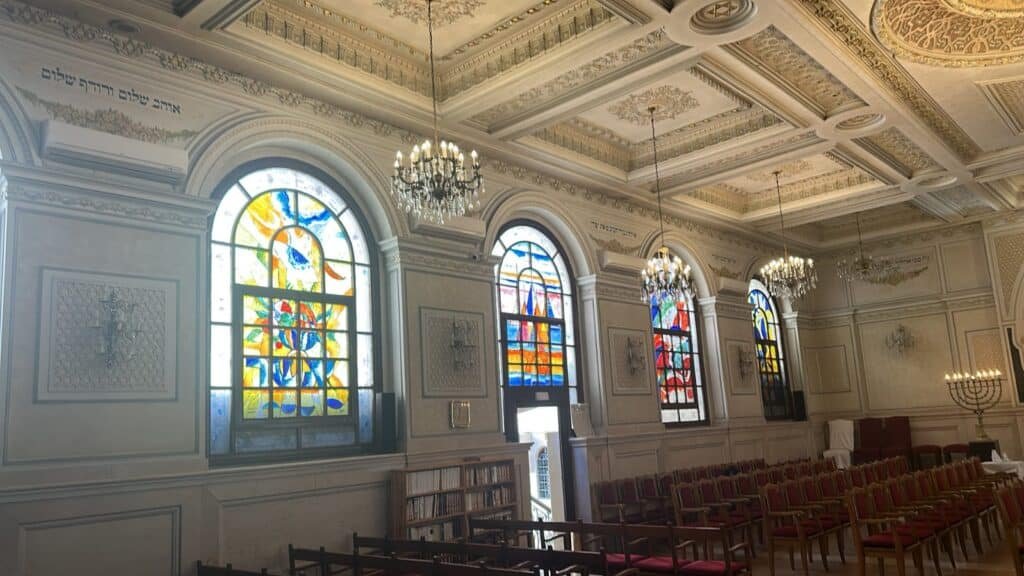
The Museum of Moroccan Judaism, the only museum of Jewish history in the Arab world, and Temple Beth-El with its stained-glass windows. The community still runs several active synagogues.
Fes
The oldest mellah in Morocco, the 17th-century Ibn Danan Synagogue and the large Jewish cemetery with its white tombs.
Meknes and Sefrou
The mellah of Meknes, built under Sultan Moulay Ismail, and the small town of Sefrou, once nicknamed “Little Jerusalem”.
Marrakech
The Mellah next to the Bahia Palace, the Slat al-Azama Synagogue, still in use, and the Miâara cemetery, the largest Jewish cemetery in Morocco.
Essaouira
Bayt Dakira, a heritage house opened in 2020, the restored Slat Attias and Haim Pinto synagogues, and the old Jewish cemetery by the ocean.
Tangier and Rabat
The Nahon Synagogue in Tangier, now a museum, and the mellahs of Rabat and Salé.
The south
Many villages of the Atlas and the oases had Jewish families. Near the Todra Gorge, the old Jewish quarter of Tinghir is a moving stop, and around Rissani lie the ruins of Sijilmassa, a caravan city where Jewish merchants traded across the Sahara.
Hiloulot: pilgrimages to the tombs of saints
Moroccan Jews venerate tsaddikim, holy rabbis whose tombs are visited during annual pilgrimages called hiloulot. One of the best known is the hiloula of Rabbi Haim Pinto in Essaouira, held each year, usually in September.
Practical tips
- Many synagogues close on Shabbat and Jewish holidays; plan visits around them.
- Kosher restaurants exist in Casablanca; elsewhere, vegetarian or fish meals are the easiest option.
- Cemetery caretakers can help you find family graves if you know the town and approximate dates.
- Dress modestly for synagogues and cemeteries.
Our Jewish heritage tours link these sites in 8 to 15 days, from the 8-day tour to the 15-day journey from Casablanca to Tangier. For background on the museum, see its encyclopedia entry.
Frequently asked questions
Are there still Jews living in Morocco?
Yes. A community of a few thousand people remains, mostly in Casablanca, with synagogues, schools and kosher shops. Many more Moroccan Jews living abroad visit every year.
What is the oldest mellah in Morocco?
The mellah of Fes, created in the 15th century next to the royal palace, was the first in Morocco.
Can you visit synagogues in Morocco?
Yes. Several synagogues are open to visitors, including Temple Beth-El in Casablanca, Ibn Danan in Fes, Slat al-Azama in Marrakech and Slat Attias in Essaouira, outside Shabbat and holidays.
What is Bayt Dakira?
A heritage house in the old Jewish quarter of Essaouira, opened in 2020, that tells the story of the city’s Jewish community.
Want to explore this heritage? Contact us to plan a private Jewish heritage tour around Shabbat and your family history.